Does digital replace plaster?
No, and we will not pretend otherwise. Plaster works, and it always will. It is simply less suited to the pressures the profession faces today: shorter delivery times, rising patient expectations and fewer hours left for fabrication. Most prosthetists start with both. They keep casting the cases they feel sure about, and scan the ones where digital saves them a step. Within two or three months the balance usually tips on its own. Nobody has to empty their plaster room on day one.
Why are prosthetists moving to digital now?
Three pressures arrived at the same time. Patients inform themselves, compare clinics and choose on outcome and turnaround rather than proximity. Experienced CPOs are retiring, and the people replacing them want methods that can be learned and passed on. And between patient load and administration, the hours left for fabrication keep shrinking. Digital answers all three: faster delivery, reproducible results, and a method that transmits.
Will I lose my expertise, or become dependent on the system?
This is the most legitimate question on this page, so here is a straight answer. Your expertise is not in handling plaster. It is in reading a limb, deciding where to load and where to relieve, and judging a fit on a patient standing in front of you. None of that moves into the software: the rectification tools reproduce the gestures you already make, and every clinical decision stays yours. What you gain is a written trace of those decisions, what you did, on which patient and why. That is what makes your work repeatable, transmissible to a colleague, and yours to keep.
Is the accuracy good enough?
Yes, when the scan is done well. Across more than 13,000 sockets, clinical outcomes are equivalent to plaster or better, and above all reproducible: the same limb scanned twice gives the same shape, which a cast never quite does. What does not change is where the accuracy comes from. The scan captures the limb, you decide what to do with it. Quality still depends on your clinical assessment, exactly as it does in plaster.
Do I need to be good with computers?
No. VYTRUVE runs in your browser on a standard laptop, and it was built for clinical use rather than for 3D modelling. There is no CAD software to learn and no 3D expertise required. Most prosthetists work independently after their first two or three transtibial cases. Before that, and any time after, you can open a case with us and we look at it together.
What do I need to get started?
A validated 3D scanner and a laptop with a browser. That is the whole list. The Medixa is our reference scanner: wireless, standalone, with nothing to configure on the computer side. The software, the scanning and the rectification are included. Fabrication is a separate choice, covered further down.
What can I actually make with it?
Check sockets and definitive sockets, at every level: transtibial, transfemoral with ischial containment, sub-ischial, and upper limb transradial. On the definitive side you choose between carbon, printed PA12 and silicone, from K1 to K4. The range is deliberately complete, so that no case type forces you back out of the platform and into a patchwork of other tools.
Do I still need my workshop?
Yes, for what a workshop is really for: fitting, adjusting, finishing and seeing your patient walk. That does not move. What becomes optional is fabrication. You can print in-house on a VYTRUVE printer with the slicing included, print on a 3D printer you already own, or send the file to our production centre and have the socket delivered in 72 hours as standard, or 48 hours express on transtibial and upper limb. Transfemoral and sub-ischial sockets stay at 72 hours. Three ways to manufacture, and you choose case by case.
What makes VYTRUVE different from generic 3D software?
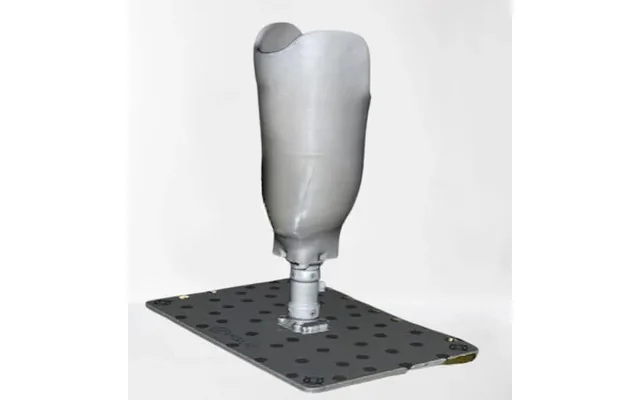
VYTRUVE is not a modelling tool with a prosthetics preset on top. It is a clinical workflow built for O&P, and two of its key pieces are patented because they did not exist anywhere else: the Vtransfer plate, which carries shape and alignment from the check socket to the definitive one, and the VTF tool, the only weight-bearing above-knee scan for a precise ischial containment socket. The practical difference is that everything happens in one place, rather than across a scanner app, a generic CAD tool and a slicer that were never designed to talk to each other.
How much does it cost?
There is no subscription, no license fee and no minimum volume. The software, the scanning and the rectification are free for as long as you use them. You pay per socket, and the hardware you choose is a one-time purchase.
See the full pricingAre VYTRUVE sockets reimbursed?
Here the honest answer is that it depends on where you practise. The principle in most systems is that what gets reimbursed is the device and the clinical work, not the method used to shape it, so a printed socket is billed like any other. Codes and requirements do differ country by country, so tell us where you are and we will go through your situation rather than hand you a generic answer.
What happens if a socket breaks?
Check sockets carry a two month warranty. If a printed socket cracks or breaks, send us the case and we look at it individually: repair, reprint or adjustment depending on what happened. And reordering from an existing file never means redoing the rectification from scratch.